Norway illustrates why airport systems, dispatch responsibility, tax reporting, driver fairness and passenger trust all depend on stronger proof of the documented ride event.
May 11, 2026·8 min read·Norway
NORWAY · NO
REF NORWAY-TAXI-REFORM · 2026-05-11
POPULATION
5.6 million2026 · UN WPP 2024 / SSB cross-check recommended
INT'L ARRIVALS
6.7 million international arrivals to registered accommodation2024 · Nordic/SSB-based visitor reporting, verify final SSB preferred field
Norway’s taxi debate is not only about apps, airports or who gets the next passenger.
It is about who controls the documented ride event.
A passenger may order through an app, a dispatch center, an airport kiosk or a traditional taxi queue. But the decisive trust moment still happens at the vehicle. Is this the right driver? The right car? The right pickup? The right price? The right route? And if something later becomes disputed, who can prove what actually happened?
Norway is useful because it is not an unregulated market. It is a serious, high-trust country that has already tested liberalization, re-regulation, dispatch-center responsibility and digital airport systems. That makes the current taxi debate a strong signal for the next layer of transport accountability.
A Signal Market in Flux
Norway’s taxi market has moved through several regulatory phases in a short period.
After the 2020 reform, the number of taxi licences rose sharply. Government sources describe how the number of licences increased from around 8,000 before the reform to more than 18,000 by June 2023. The same official review noted that some issued licences may not have been in active use, but the direction was clear: the market had become much harder to read.
The concern was not only that there were more licences. It was that the relationship between licence holder, driver, dispatch center, app, passenger and regulator had become less transparent.
That matters because Norway still has a large taxi market. Statistics Norway reported that taxis drove 292 million passenger kilometres in 2023, a seven percent increase from 2022 and four percent above 2019, the last full year before the pandemic.
So the policy question is not theoretical. It affects airports, cities, districts, public contracts, passengers, drivers and tax reporting.
The Airport Is Where Accountability Becomes Visible
The clearest conflict is now visible at the airport.
In September 2025, announced an agreement with Fast Travel for curbside operations at five of Norway’s largest airports: Tromsø, Bergen, Stavanger, Trondheim and Oslo. In a written parliamentary question, Fast Travel was described as a taxi ordering system introduced by Avinor at several airports. Travellers use a terminal in the arrival hall, enter their destination and see an estimated price before the trip. Only drivers with individual agreements with Fast Travel can drive forward to the terminal zone.
That is not just a queue-management detail.
Airport taxi systems can change who controls the passenger interface, who gets access to pickup areas, how prices are shown, how complaints are routed and who becomes responsible when the passenger experience fails.
The conflict became concrete at Stavanger lufthavn, Sola. Taxi drivers protested the system, arguing that the model created price-based competition, income pressure and social dumping. A written parliamentary question described how only drivers with individual Fast Travel agreements could access the terminal zone, and how drivers experienced the model as forcing individual competition for trips. Avinor rejected the social-dumping claim, stating that prices are set by licence holders or taxi centers, not by Avinor or Fast Travel, and that the system is intended to create safer traffic flow, clearer queues, free taxi choice and upfront pricing.
This is why the Norwegian debate is bigger than one airport contract. It touches the whole accountability chain.
Warning Signs Are Not a Trust System
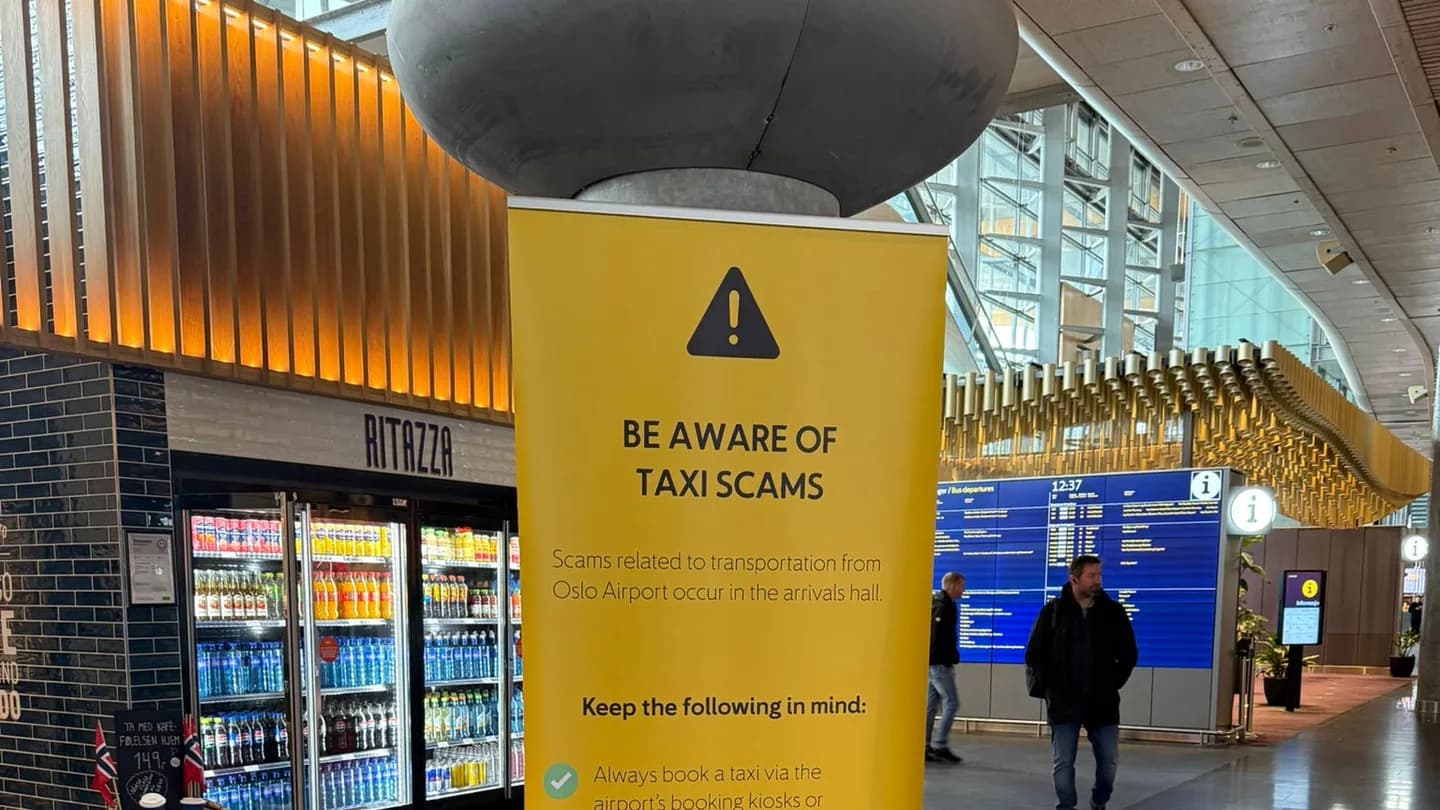
In March 2026, Aftenposten reported that Avinor had put up warning signs at Gardermoen to alert passengers about taxi scams. The report described cases where some drivers entered the arrival hall to capture passengers before they reached the ordering machines. That allowed them to charge more than the trip would have cost through the machine, while also bypassing the taxi queue.
The reputational point matters too. Aftenposten quoted Jarle Kanaris from Bytaxi saying that the warning signs were “ingen god norgesreklame”. In other words, the issue is not only whether one passenger is overcharged. It is also whether Norway’s first transport impression at the national airport feels orderly, trustworthy and professional.
This is the exact kind of event SafetyRide is built to think about.
The problem is not only that a passenger may be overcharged. The deeper issue is that the formal ordering system, the physical driver, the vehicle, the queue, the fare and the passenger handoff can separate from each other.
When that happens, a market can have rules, signs, kiosks and dispatch structures, and still lack clear proof at the moment trust becomes physical.
That is the wider damage caused by a small minority. A few drivers can create fear, irritation and suspicion that affects an entire airport, a city and a national visitor experience. They can also damage the reputation of serious taxi drivers who follow the rules.
A stronger verification layer should make it close to impossible to exploit arriving passengers without being identified, linked to the vehicle and connected to a documented pickup event. That protects the traveller, but it also protects Norway’s legitimate taxi market from being judged by the behaviour of the few.
The Industry Concern Is About Responsibility
has criticized Avinor’s new airport model as more than a traffic measure. The association argues that central functions and decision-making are being moved away from taxi dispatch centers and toward a commercial actor, without the same overall responsibility that regulation places on traditional dispatch centers.
The association’s argument is important because it is not only defensive industry rhetoric. It goes directly to the core question: who controls the documented ride event, and does responsibility follow that control?
Norges Taxiforbund also warns that the model makes price a dominant competition factor, increases pressure on income, weakens predictability and creates uncertainty for licence holders. It also argues that Fast Travel gains operational and commercial influence without being subject to the same regulatory responsibility as taxi dispatch centers.
This is where market fairness becomes part of safety.
If the actor controlling access, price presentation, fleet behaviour, complaint pathways or customer flow does not carry the same responsibility as the operator performing the transport, the value chain becomes harder to trust.
Tax Reporting Shows the Same Problem From Another Angle
Norway’s taxi debate is also about public finance and reporting.
In a written answer to Parliament, the Minister of Finance noted that intermediaries of taxi services have a duty to report third-party information about licence holders’ turnover to the tax authorities, and that this duty applies both to platform companies and traditional taxi dispatch centers.
That is a major signal.
The documented ride event is not only relevant for passengers and drivers. It is also relevant for tax, turnover, kilometres, booking data and public oversight. If the market cannot clearly connect driver, vehicle, trip, payment and platform role, accountability becomes weaker across the value chain.
The same direction appears in the re-regulation of the industry. A 2025 parliamentary law decision states that taxi licence holders must be affiliated with a dispatch center, must report the information the dispatch center needs to fulfil its duties, and must ensure that payment for licence-required taxi transport is registered in approved control equipment through that dispatch relationship.
In other words, Norway is trying to rebuild responsibility around the taxi event.
The Physical Vehicle Still Matters
A government proposition from 2025 makes the physical point even clearer. It states that there were no known solutions where fixed connection to the vehicle was secured in another safe way than through physical connection, and that the taximeter was currently the only known solution with physical connection to the vehicle.
That sentence is strategically important.
It shows that the Norwegian regulatory system already understands something SafetyRide is built around: digital ordering alone is not enough. The market also needs reliable connection to the physical vehicle.
SafetyRide does not need to replace Norway’s taxi regulation, dispatch centers, taximeters or airport systems. Its relevance is that the real-world trip needs a stronger evidence layer around those systems.
Passenger Rights Are Real. Proof Still Matters.
Norway already gives passengers important rights.
states that passengers are free to choose the taxi they want, also in a taxi queue. It also explains that if a taxi takes the wrong route, the passenger may ask the driver to stop the taximeter and may claim a price reduction if the driver did not choose the fastest route.
Those are useful rights. But rights work best when facts can be documented.
If a trip is disputed, the question quickly becomes practical: Which car was used? Which driver performed the trip? Where was pickup? What price was shown? What route was taken? Was the trip ordered through the intended channel? Was the passenger intercepted before the official system? Did the driver follow the expected queue and fare logic?
The stronger the event evidence, the stronger the right.
The missing layer is a ride-level record
Norway’s strongest signal is not one scandal or one platform dispute. It is the pattern.
The country has liberalized and re-regulated. It has reintroduced stronger dispatch-center logic. It has airport systems that shift control over pickup and price presentation. It has warning signs against taxi scams at the national airport. It has tax reporting duties for both platforms and traditional dispatch centers. It has industry concern about commercial control without matching responsibility.
All these signals point to the same missing layer.
Norway does not only need better apps, signs, queues or complaint rules. It needs stronger proof of the transport event itself.
Who controlled the passenger handoff? Who carried the regulatory responsibility? Which vehicle was actually used? Which driver performed the trip? What fare was shown? What route was taken? What data can be trusted if the passenger, driver, dispatch center, airport, tax authority, insurer or regulator later needs to understand the event?
That is the accountability layer Norway’s taxi debate is now moving toward.
Where SafetyRide fits
SafetyRide belongs in Norway because the debate is already about trust, access and accountability after deregulation. The missing element is a visible ride record that protects passengers without treating serious drivers as the problem.
Continue
Read more from SafetyRide.
Browse the rest of the articles, or get in touch about anything you read here.