Italy’s taxi and NCC market needs a clearer trust record
Italy’s tourism scale, licensed taxi rules, NCC conflict, visitor warnings and repeated transport disputes show how regulation is not the same as proof of the physical ride.
May 11, 2026·6 min read·Italy
ITALY · IT
REF ITALY-TAXI-NCC · 2026-05-11
POPULATION
58.7 million2026 · UN WPP 2024 / ISTAT cross-check recommended
INT'L ARRIVALS
~65-88 million international visitors/arrivals depending on measure2024 · ISTAT accommodation statistics / UN Tourism-style arrivals, verify exact preferred definition
DRIVER COUNT
~40,000 taxi and NCC driverslatest available
Italy does not have a simple transport problem.
It has a trust problem inside a mature, regulated and politically sensitive market.
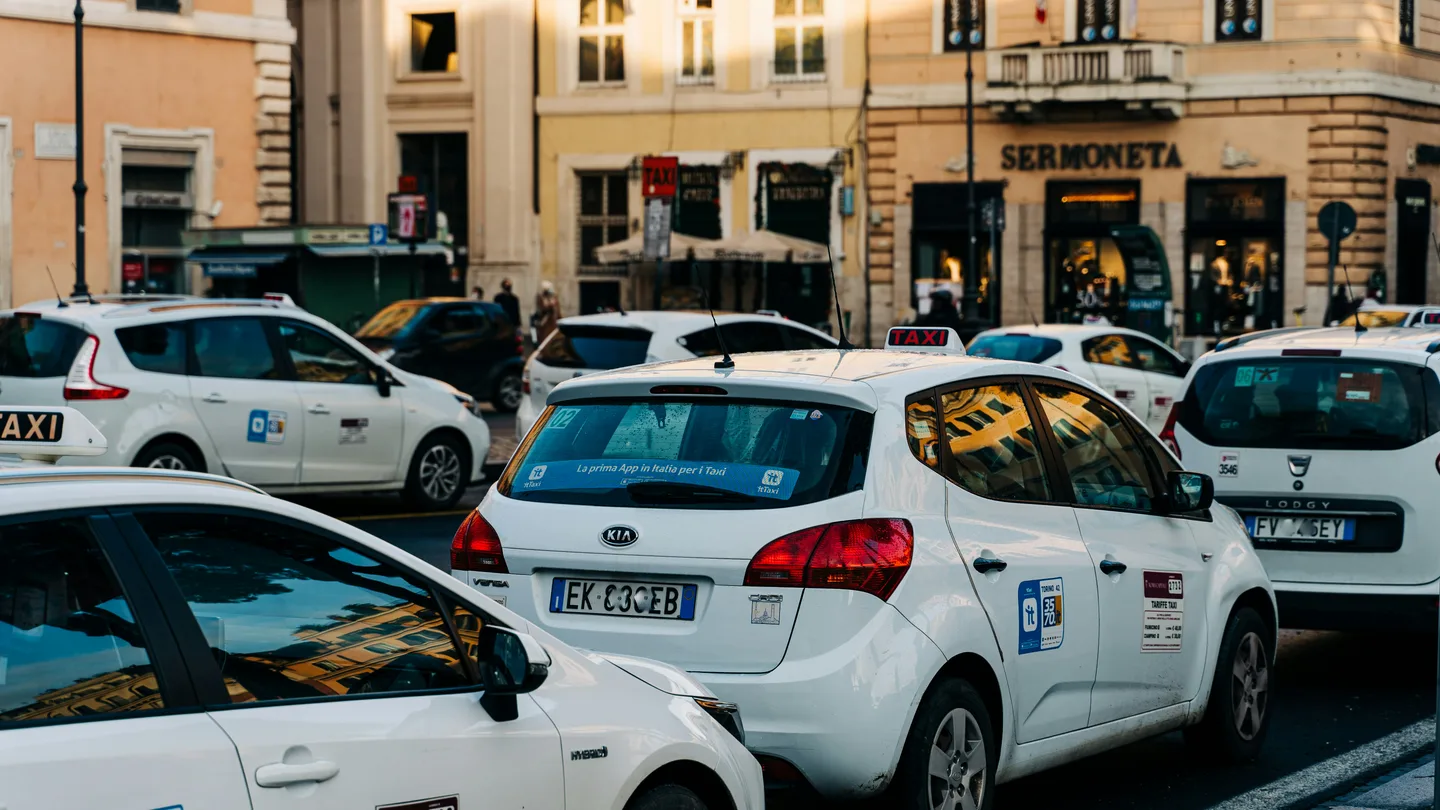
A visitor arriving in Rome, Milan, Naples, Venice or Florence may meet official taxis, hotel transfers, chauffeur services, app-mediated rides, airport fixed fares and informal approaches. Most rides are legitimate. Most drivers are serious. But the passenger still has to understand the system quickly, often at the exact moment when they are tired, carrying luggage and trying to leave an airport or station.
That is where trust becomes physical.
The Visitor Is Told to Verify the Ride
The UK’s official Italy travel advice tells travellers to use only officially licensed taxis, which have a taxi sign on the roof and a company name and number written on the side. It also advises travellers to call a taxi, order one from an app or use an official rank.
That is useful advice.
It also reveals the underlying problem.
The passenger is expected to identify whether the vehicle, driver and pickup channel are legitimate. A roof sign, side marking, app order or official rank can help. But the passenger is still the one making the judgement at the curb.
In a familiar city, that may feel easy. In a foreign city, late at night, outside a terminal or with children and luggage, it is a different kind of decision.
SafetyRide’s point is not that Italian taxis are unsafe. The point is that a market can be regulated and still need stronger proof of the ride itself.
Taxi Shortage, Strikes and App Conflict Show the Pressure
Italy’s taxi market is also under pressure from a different direction: supply, competition and platform change.
The Financial Times reported in 2024 that Italian taxi drivers staged strikes against the government, amid pressure over taxi availability, consumer frustration, new taxi licences and the role of Uber and other app-based services. The same reporting described the sector as politically powerful, while consumers and competition authorities argued for more supply and better service quality.
That conflict matters because it is not only about convenience.
When taxis are scarce, passengers may wait longer, accept alternative offers, use different apps, follow informal advice or choose transfers they do not fully understand. When drivers feel threatened by deregulation, app-based competition or irregular NCC services, trust and fairness become market issues, not only passenger issues.
In 2026, Italian taxi unions again called national strike action, demanding stricter regulation of multinational ride-hailing apps and clearer rules around competition. Reporting from Rome and Naples also linked protests to concerns about irregular NCC services and multinational platforms.
This is where SafetyRide’s position must be precise.
SafetyRide is not another ride-hailing competitor. It should not take sides in a taxi-versus-app fight. It should ask the deeper question: whichever service is used, can the real-world ride be verified?
Algorithms, NCC and the Fight for Fair Access
Italy’s taxi conflict is also a market-fairness conflict.
In January 2026, reported a 24-hour taxi strike involving around 20 unions. The strike targeted what unions described as unfair competition from Uber, algorithm-driven systems, irregular activity and the absence of clear rules for digital platforms.
Reuters Connect later described taxi drivers rallying in Naples in May 2026 against multinationals such as Uber and competition from irregular NCC services. Wanted in Rome also reported national strike action demanding stricter regulation of multinational ride-hailing apps.
This does not need to be framed as anti-platform.
The better question is whether the people and companies influencing price, demand, market access and passenger flow carry the same visible responsibility as those performing the physical ride. If a digital intermediary, NCC operator, taxi driver, platform, airport or hotel transfer all touch the same passenger journey, the market needs clearer proof of who did what.
Market fairness and passenger safety are not separate issues. Both depend on a transport event that can be verified.
NCC Illustrates Why Category Labels Are Not Enough
Italy’s NCC services are an important part of the same trust chain.
NCC, or “noleggio con conducente”, refers to chauffeur-driven hire vehicles. These services are not the same as taxis, and the legal distinction matters. Taxi drivers have long argued that some NCC or app-mediated activity can blur the line between pre-booked chauffeur service and taxi-like street service. NCC representatives, on the other hand, have argued for modernised rules and warned that strike threats and regulatory uncertainty damage the sector.
Agenzia Nova reported in December 2025 that NCC Italia welcomed progress on reforming non-scheduled transport, describing the reform process as a needed step toward clearer, updated and coherent rules.
That is the right word: clearer.
Italy does not lack transport categories. What it lacks is a simple way to prove that the physical ride matched the category, driver, vehicle and pickup the passenger believed they were using.
Was this a taxi? Was it an NCC service? Was it pre-booked? Was it app-mediated? Was the driver authorised for this ride? Did the passenger enter the expected vehicle? Was the fare, pickup point and route connected to the right service model?
A category label can answer some of that. It cannot answer all of it.
Traveller Stories Are a Perception Signal
Italy also has a familiar traveller-perception problem around airport taxis and unofficial approaches.
Travel forums and visitor guides frequently discuss Rome airport taxis, fixed fares, unofficial drivers, confusion around official ranks and concern about being overcharged. These accounts are perception signals, not hard statistical evidence.
But perception matters in tourism.
If enough travellers are worried about whether a taxi is official, whether the flat fare is real, whether the driver will use the correct fare, or whether a person approaching them is legitimate, the market has a trust-design problem even when the majority of trips are normal.
The solution is not to shame a country or a profession. It is to reduce ambiguity.
A visitor should not need to become a local transport expert at the airport curb.
That ambiguity is where a few bad actors can damage trust for many. If visitors repeatedly hear about unofficial approaches, inflated airport fares or confusing pickup situations, the suspicion can spread to serious taxi drivers, NCC operators, hotels and local transport partners who are doing things properly.
Documented transport should make it much harder to exploit a visitor’s lack of local knowledge, and much easier for legitimate operators to show that the physical ride matches the authorised service the passenger believed they were using.
Road Safety Adds the Incident Context
Italy’s transport trust problem is not only about fares and access.
’s preliminary road-accident estimates for January to June 2025 recorded 1,310 road deaths and 145,785 injuries. The numbers were down from the same period in 2024, but they still show that road transport remains a serious public-interest environment.
This should not be used as a taxi-specific claim. It is not.
The point is broader: when a transport event becomes an incident, context matters. Vehicle, driver, route, pickup, timeline and trip status can become relevant for passengers, drivers, operators, insurers, police and regulators.
That is why verified ride context matters even in a mature European market.
The Missing Layer Is the Verified Ride
Italy already has official taxis, NCC services, apps, airport ranks, visitor guidance, fixed fares and regulation.
What it does not consistently have is a neutral evidence layer that connects the physical ride to the transport relationship.
Who was the driver? Which vehicle was used? Was the ride a taxi, NCC, app-mediated trip or hotel transfer? Was the pickup official? Was the route and fare connected to the right category? What evidence exists if the passenger, driver, operator, airport, hotel, insurer or regulator later needs to understand the event?
That is the gap SafetyRide is built around.
Where SafetyRide fits
SafetyRide belongs in Italy by helping licensed taxis, NCC operators, hotels and airports show which service the passenger is actually entering. It supports local distinctions instead of flattening them into one generic app model.
Continue
Read more from SafetyRide.
Browse the rest of the articles, or get in touch about anything you read here.